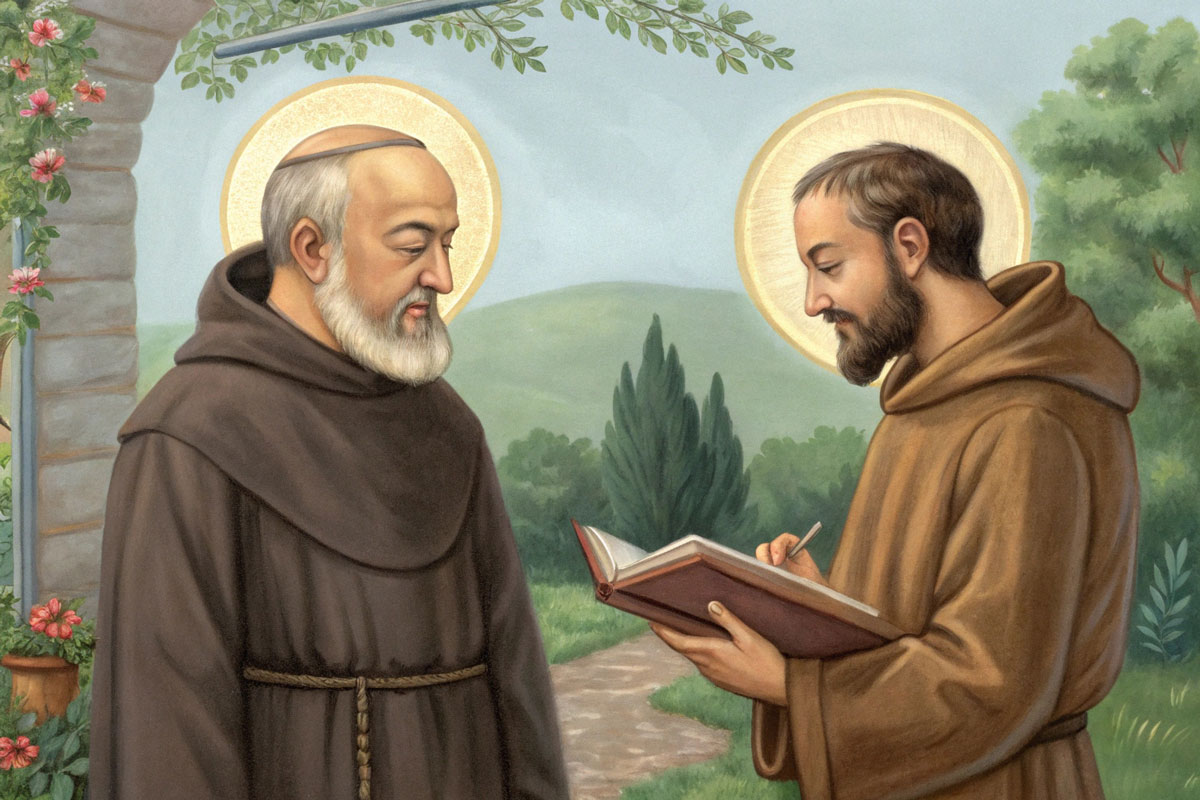
Throughout Christian history, few saints have captured the imagination and devotion of the faithful quite like St. Francis of Assisi and Padre Pio of Pietrelcina. Though separated by more than seven centuries, these two spiritual giants are bound by deep similarities—not only in their love for Christ but through the extraordinary, visible sign of their devotion: the stigmata, the wounds of Christ’s Passion.
But beyond the mystical phenomenon lies a deeper connection—a shared spirit of humility, suffering, and total surrender to God. Together, they represent two expressions of the same Gospel fire, lived out in different times but with the same burning intensity.
St. Francis of Assisi: The First Stigmatic
Born in 1181/82, Francis of Assisi was a man of wealth and privilege who renounced everything to follow Christ in radical poverty. His love for the poor, nature, and simplicity made him one of the most beloved saints of all time. But it was during his retreat on Mount La Verna in 1224 that Francis experienced something extraordinary: the appearance of a seraphic figure of Christ crucified, and shortly after, he received the stigmata—becoming the first known person in history to bear these visible wounds.
For Francis, the stigmata was not a badge of honor but a participation in the sufferings of Christ. His wounds bled and caused him constant pain, yet he bore them in silence and joy, viewing them as a seal of divine love.
Padre Pio: The Modern Stigmatic
In a very different time—early 20th-century Italy—Francesco Forgione, later known as Padre Pio, was a Capuchin friar deeply devoted to prayer, penance, and the Eucharist. In 1918, while praying before a crucifix after Mass, Padre Pio received the visible stigmata, just like St. Francis. The wounds appeared on his hands, feet, and side and remained for fifty years, bleeding and causing him physical pain and social scrutiny.
Unlike Francis, who lived in an age of widespread belief in miracles, Padre Pio’s wounds were subject to medical investigations and skepticism, even from within the Church. But those who knew him witnessed profound holiness and healing through his suffering. He bore the stigmata in obedience and silence, never seeking attention, and used his suffering to intercede for the souls of others.
Shared Charisms and Spiritual Kinship
Despite the centuries between them, Padre Pio and St. Francis shared striking similarities:
- Both were members of the Franciscan family: Francis as the founder, Padre Pio as a Capuchin friar, a reformed branch of the Franciscan order.
- Both received the stigmata as a profound mystical grace, bearing the physical wounds of Christ with humility.
- Both embraced radical poverty and simplicity, despite living in very different social contexts.
- Both inspired renewal within the Church: Francis through a return to Gospel simplicity, and Padre Pio through a deep emphasis on confession, prayer, and personal holiness.
- Both attracted multitudes, drawn to their sanctity, miracles, and spiritual guidance.
Their lives remind the faithful that holiness transcends time—that God raises up saints in every age who bear witness not only through words, but through their very bodies.
One Spirit, Many Souls
It’s often said that Padre Pio was a “new St. Francis” for the modern world. While Francis called his followers to rebuild the Church in a time of moral laxity, Pio brought souls back to God in an era of secularism and doubt. Both saints bore the cross visibly, and both allowed that suffering to become a source of grace for others.
Their shared stigmata is a mystery, but not a coincidence. It points to a profound spiritual unity: both men became living icons of the Crucified Christ.
Conclusion: Following in Their Footsteps
St. Francis of Assisi and Padre Pio invite us to a deeper union with Christ through prayer, humility, and love. Their wounds—so misunderstood by the world—were in fact divine messages, testifying to the cost of love and the call to holiness.
Whether you feel drawn to Francis’s joyful simplicity or Pio’s contemplative suffering, both saints remind us that the path to heaven often passes through the wounds of Christ—and through them, a deeper love.