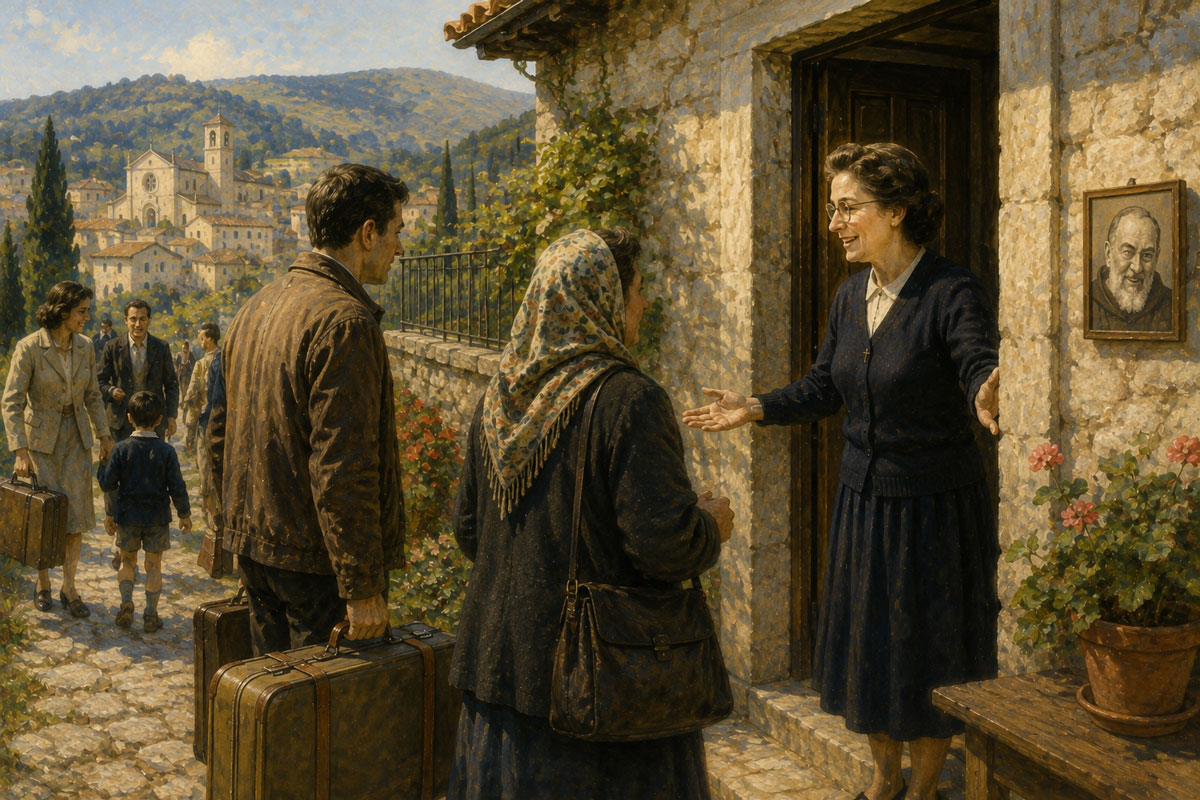
Mary Pyle might have seemed an unlikely person to become closely connected with one of the most remarkable Catholic figures of the twentieth century. Born in the United States and raised in a life far removed from the simplicity of San Giovanni Rotondo, she eventually left behind much of what was familiar and made Padre Pio’s world the center of her life.
Her story raises an interesting question: why was Mary Pyle so well suited to the work that developed around Padre Pio? The answer is found not in one extraordinary ability, but in a combination of faith, determination, practical competence, loyalty, and a remarkable willingness to make herself available.
She Was Willing to Leave the Familiar Behind
Every vocation begins with some form of response. For Mary, that response eventually meant building a life very different from the one she might once have imagined for herself.
Her devotion to Padre Pio was not merely an admiration maintained from a comfortable distance. She reorganized her life around service. That willingness to leave security behind created the freedom necessary for her to take on responsibilities that could not have been fulfilled through occasional involvement.
She Brought Practical Gifts to a Spiritual Mission
When we think about religious missions, it is natural to focus on prayer, preaching, or explicitly spiritual work. But every mission also depends upon ordinary things being done well. People must be welcomed. Messages must be handled. Arrangements must be made. Problems must be solved.
Mary Pyle possessed the practical abilities needed for this hidden side of ministry. Her contribution reminds us that organization, hospitality, reliability, and attention to everyday needs can become genuine forms of Christian service when they are placed at God’s disposal.
She Could Serve Without Being the Center
Padre Pio naturally attracted enormous attention. As pilgrims increasingly came seeking his prayers and spiritual guidance, those around him had to understand that their role was to support a mission that was not about themselves.
Mary was capable of remaining close to something extraordinary without needing to become its central figure. This humility was essential. She could devote herself to work whose value was measured by what it made possible for others rather than by the recognition she personally received.
She Understood the Needs of Pilgrims
Mary’s own journey gave her a particular understanding of what it meant to arrive in an unfamiliar place seeking Padre Pio. She knew what it was like to travel from another country, encounter a different culture, and navigate the practical challenges surrounding a pilgrimage.
That experience helped make her especially useful to other visitors. Hospitality became more than politeness. It became a way of helping people reach the spiritual encounter for which they had traveled so far.
She Was Prepared to Stay
Many people are willing to help for a short time. Far fewer are prepared to remain when service becomes repetitive, inconvenient, exhausting, or largely unnoticed.
One of Mary’s greatest gifts was constancy. Her contribution was not defined by a single dramatic moment but by years of presence. She kept returning to the responsibilities before her, allowing reliability itself to become part of her vocation.
Her Lay Vocation Mattered
Mary Pyle was not a religious sister. That fact makes her place in Padre Pio’s story particularly meaningful for lay Catholics. She demonstrates that important work within the Church has always depended upon people whose vocation is lived outside monasteries and convents.
Her life shows that laypeople do not merely stand at the edges of spiritual missions. Their professional skills, relationships, resources, hospitality, and willingness to serve can become essential parts of how those missions grow.
She Turned Friendship Into Service
Mary’s devotion to Padre Pio was deeply personal, but it did not remain merely sentimental. Affection became responsibility. Respect became service. Spiritual friendship produced practical action.
This is one of the most compelling aspects of her story. Genuine devotion eventually asks something of us. It moves beyond admiration and begins changing how we spend our time, use our abilities, and respond to the needs around us.
God Often Uses the Person Who Is Available
Looking back at Mary Pyle’s life, it can be tempting to imagine that she possessed some obvious quality that destined her for this particular role. Yet her story suggests something simpler. She was willing to be available.
She had abilities that could be used, circumstances that allowed her to respond, and enough faith to continue saying yes as one responsibility led to another. Over time, those ordinary acts of availability became an extraordinary commitment.
The Mission Behind the Mission
The public remembers figures such as Padre Pio, but every great spiritual work is surrounded by quieter lives that help sustain it. Meals are prepared, visitors are welcomed, correspondence is answered, journeys are arranged, and countless practical problems are solved by people whose names may never become widely known.
Mary Pyle represents this hidden network of service beautifully. Her life reminds us that God does not only call the person standing before the crowd. He also calls the person willing to prepare the room, open the door, welcome the stranger, and remain when everyone else has gone home.
Perhaps that is one reason Mary Pyle was so well suited to Padre Pio’s mission. She was willing to make another person’s calling easier to fulfill—and to allow her own calling to be discovered in the process.